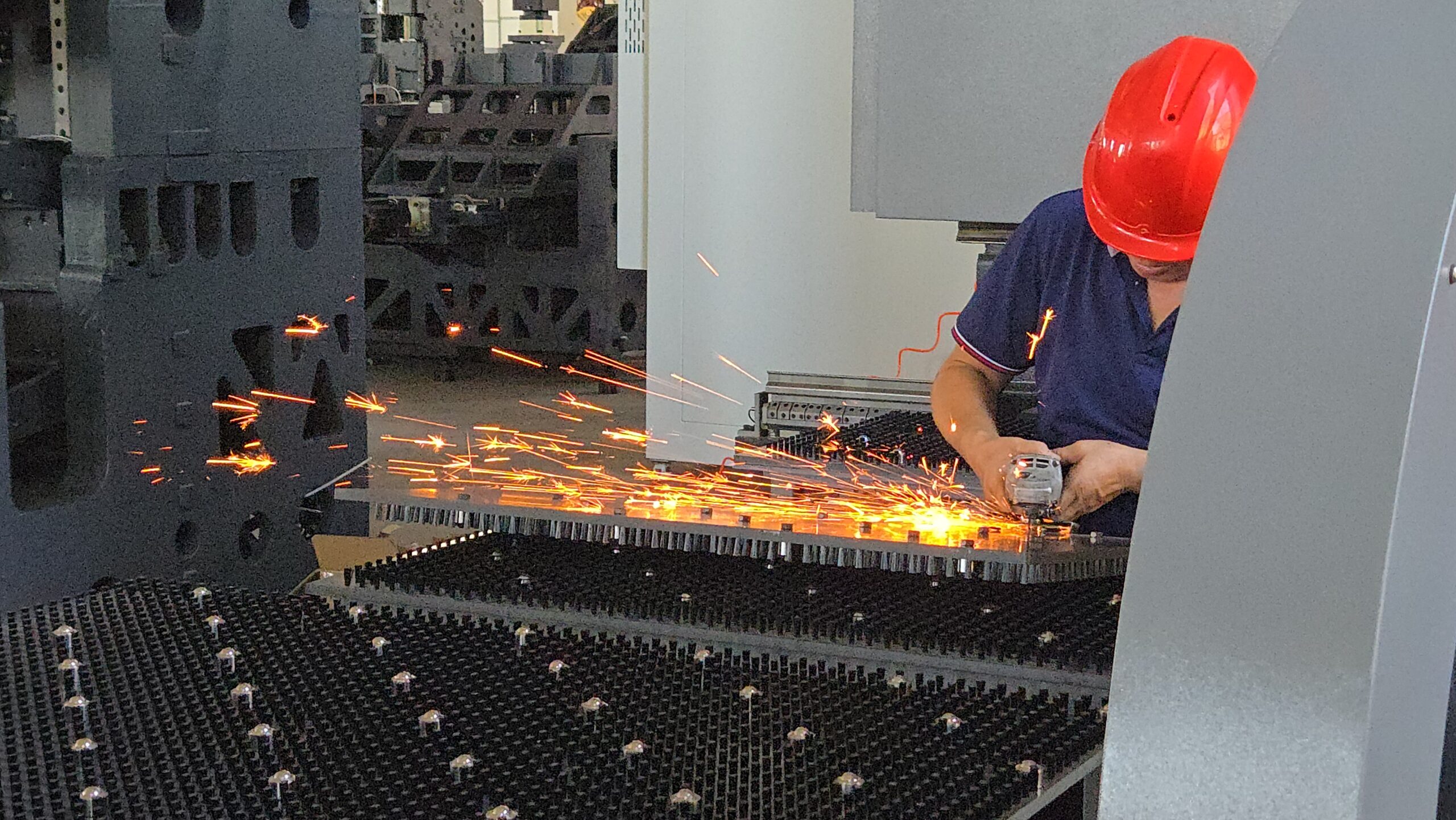
Buying a fiber laser cutting machine is a significant investment.
For manufacturers, the biggest mistake is often focusing on one specification—usually laser power—while overlooking the complete production process.
A better approach is to start with the materials, parts, production volume, and future requirements.
1. Start With Your Materials
Identify all materials currently processed in your factory.
Typical materials include:
- Mild steel
- Stainless steel
- Aluminum
- Galvanized steel
- Copper, brass, or other reflective materials depending on the application
Different materials have different cutting characteristics.
Your supplier should understand the complete material range rather than recommending a machine based on one sample sheet.
2. Define Your Thickness Range
Determine:
- Minimum thickness
- Typical thickness
- Maximum thickness
The maximum thickness is important, but your typical production thickness may be even more important when evaluating productivity.
If 80% of your production consists of thin and medium-gauge material, machine configuration should reflect that reality.
3. Choose the Appropriate Laser Power
Laser power should be selected according to the required material and thickness range.
Higher power can provide greater cutting capability, particularly for thicker materials.
However, higher power also means higher equipment investment.
The objective is not to purchase the most powerful machine available.
It is to purchase enough power to meet your actual production requirements with appropriate capacity for future growth.
4. Consider Sheet Size
Common working areas include different combinations of length and width.
Your choice should be based on the sheet sizes actually used in production.
Consider:
- Standard sheet dimensions
- Largest parts
- Material utilization
- Future product development
A working area that is too small can create unnecessary cutting limitations.
An unnecessarily large machine, however, may increase investment and floor-space requirements.
5. Look at Cutting Speed in Context
Machine suppliers often highlight maximum cutting speeds.
Maximum speed is useful information, but it should not be treated as the only indicator of productivity.
Actual production time depends on:
- Material
- Thickness
- Part geometry
- Number of piercings
- Cutting length
- Acceleration and deceleration
- Sheet loading
- Unloading
- Sorting
For production planning, total cycle time is more meaningful than maximum head speed.
6. Evaluate the CNC and Software
Modern laser cutting is a digital process.
The control and software environment affects:
- Programming
- Nesting
- Cutting parameter management
- Production scheduling
- Machine monitoring
- File management
A user-friendly system can reduce programming time and make it easier for operators to manage different jobs.
7. Consider Automation From the Beginning
If production volume is increasing, automation should be part of the initial discussion.
Possible options include:
- Automatic loading
- Automatic unloading
- Sheet storage
- Sorting
- Material handling
- Production scheduling
An automated laser cutting system can significantly reduce manual material movement.
For example:
Sheet Storage → Automatic Loading → Laser Cutting → Automatic Unloading → Sorting → Bending
This is particularly valuable when laser cutting becomes one part of a larger automated production line.
8. Think About Your Next Three Years
A laser cutting machine may remain in production for many years.
Don’t only ask:
“What do we cut today?”
Also ask:
“What will we probably cut in three years?”
Consider whether you expect:
- Higher production volume
- Thicker materials
- Larger sheets
- New product categories
- More automation
- Integration with bending
A reasonable amount of future capacity can protect your investment.
9. Evaluate the Complete Cost
The machine purchase price is only one part of the investment.
Also consider:
- Installation
- Training
- Electricity
- Assist gas
- Consumables
- Maintenance
- Spare parts
- Software
- Automation
- Downtime
- Technical support
A machine with a lower purchase price may not necessarily have the lowest total operating cost.
10. Test Your Real Parts
Before purchasing, provide the supplier with representative production samples.
Ideally, include:
- Thin material
- Typical material
- Maximum thickness
- Complex contours
- Small holes
- Long cuts
- Reflective materials if relevant
Ask for cutting samples and production data.
This gives you a much more realistic basis for comparison than a standard showroom demonstration.
Fiber Laser and Bending: The Bigger Picture
Laser cutting should not be considered in isolation.
In many sheet metal factories, cutting is only the first stage.
The complete process may be:
Laser Cutting → Sorting → Bending → Welding → Assembly
If cutting and bending are planned together, manufacturers can improve material flow and reduce unnecessary handling.
This is where integrated automation becomes increasingly valuable.
Conclusion
Choosing a fiber laser cutting machine should begin with your production requirements, not a single machine specification.
The most important factors include:
Material + Thickness + Sheet Size + Production Volume + Cutting Requirements + Automation + Future Demand
A properly selected fiber laser can become the foundation of a highly efficient sheet metal production process.
KLD Machinery provides fiber laser cutting solutions with the option to connect cutting, material handling, bending, and automation into a more integrated production system.