Adding Process Intelligence to Automated Bending
Automating sheet metal bending requires more than mechanical movement.
The system also needs information about the workpiece.
For manufacturers processing different sheet metal products, material thickness can be an important process variable.
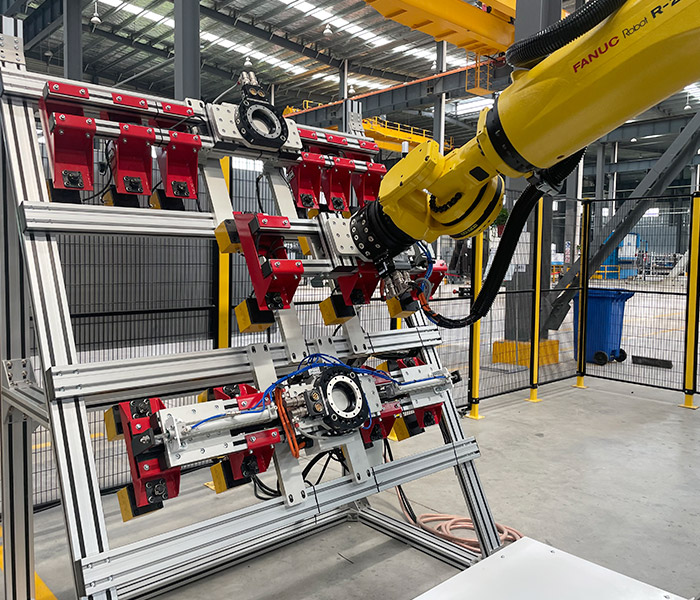
In this KLD automation case, automatic thickness detection is integrated into a robotic bending cell designed for large and diverse sheet metal components.
Why Thickness Matters
Sheet metal bending parameters are influenced by material characteristics and thickness.
When the material specification changes, the bending process may also need to change.
In a manual production environment, an operator can identify material information through production instructions and direct inspection.
In an automated environment, the system can use sensors and detection functions to obtain relevant information automatically.
Automatic Thickness Detection
The KLD solution incorporates an automatic thickness detection function.
The system can detect the thickness of the workpiece and use this information as part of the automated production process.
This is particularly useful when different products or material specifications are processed on the same bending cell.
It reduces dependence on manual measurement and helps establish a more controlled production workflow.
Combined With 3D Vision
Thickness detection is only one part of the sensing architecture.
The cell also incorporates 3D vision.
Together, these technologies provide additional information about the workpiece.
The vision system supports recognition and positioning, while thickness detection provides information about material thickness.
This creates a more intelligent interaction between:
Workpiece → Sensors → Control System → Robot → Press Brake
Why This Matters for Flexible Manufacturing
A highly automated production line can become difficult to manage if every production change requires manual parameter confirmation.
Automatic detection can reduce some of these manual steps.
This becomes increasingly valuable when the factory produces:
- Multiple product types
- Different sheet sizes
- Different material thicknesses
- Large and heavy workpieces
- Small production batches within a mixed product environment
The goal is not to eliminate operator involvement completely.
The goal is to reduce unnecessary manual decisions and make the production process more repeatable.
Integrated Positioning
The KLD system also includes an adjustable-angle gravity positioning table and automatic positioning systems.
These components help establish a consistent relationship between the workpiece and the bending machine.
Combined with a 6-axis robot and 7th axis, the system can handle large workpieces while maintaining a controlled production sequence.
What Does This Mean for Buyers?
When evaluating automated bending equipment, manufacturers should ask:
- How does the system identify different workpieces?
- How is material thickness verified?
- How does the machine react when specifications change?
- Can the system handle multiple product types?
- How much manual setup is still required?
These questions are often more important than simply asking for the robot model or press brake tonnage.
Conclusion
Modern sheet metal automation is increasingly moving from simple mechanical automation toward sensing and intelligent process control.
Automatic thickness detection and 3D vision can provide the information required to make robotic bending more adaptable to real production environments.
In this KLD case, these technologies form part of a larger flexible bending system designed for large, thick, and diverse sheet metal components.
KLD Machinery develops automation solutions that combine robotics, sensing, positioning, CNC bending, and material handling around the customer’s actual production requirements.